
Police Promotion Information and Resources
Everything You Need to Know to Plan For and Achieve Promotion Up the Ranks in Law Enforcement!

Great Police Leaders Focus On the Details
— Every Day, Every Officer, Every Decision!
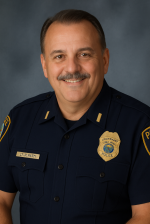
By Lt. Paul Patti (ret) - Director
Police
Career and Promotion Services, LLC.
 What you need to know
about all aspects of preparing for and achieving your promotion in
law enforcement can be found in these pages.
What you need to know
about all aspects of preparing for and achieving your promotion in
law enforcement can be found in these pages.
About us: I spent 27 years in law enforcement, and since 1985 I have directed an organization that has worked with individuals and agencies in finding and promoting the right people into the higher ranks of police and sheriff's departments. We include a Ph.D. in Personnel Management, as well as a staff attorney focusing on criminal law applications in law enforcement. We specialize not only in writing promotion textbook exams for police agencies, but also written exam preparation for individuals, along with in-basket, oral board and assessment center preparation for both agencies and individual training. Our individual client base has a 99%+ pass rate on their written exams!
More information about me, my organization and affiliates can be found at these links; PoliceCareer.com, About Us, PoliceCareer.net, PolicePromotion.com, Finests.com, In-Basket.net and PoliceAssessmentCenter.com.
Master List of Articles. Questions? Contact me - Paul@PolicePromotion.com
If You Want to Be a Great Police Leader You MUST Demonstrate Your
Attention to the Details!
By Lt. Paul Patti (ret.), Director,
Police Career and Promotion Services, LLC — 40+ years of law
enforcement promotion expertise.
Paying Attention to the Details Means
Never Being Surprised!
I've been involved in Police
Promotion Written Exams, Oral Boards and Assessments since
1985. So, as you can imagine, I've been asked A LOT of
questions about the promotion process, BUT the question I
get the MOST is this one;
"What is the #1 most
important thing I can do to make sure I get the promotion?"
The question is an excellent one. Here is the
straightforward answer;
"Be detail oriented." Sounds
simple, right? It's not. I'm always asked to explain what I
mean; so here it is;
From the moment that you start
your career in the police academy, EVERYONE in the police
agency is watching you, and sizing you up. They are asking
themselves, "Is this the future chief, or maybe patrol
captain? Are they good enough to be a corporal, or how about
sergeant?"
And then, years later, when you are
finally eligible to take your first promotion exam, the
question is asked again, multiple times, in many different
variations.
But - it all comes down to: "Is this
person detail oriented?"
Ok, so by this point you
should be asking just what I mean by "detail oriented." It
will be easier and quicker if I just point out to you what
is NOT detail oriented;
Walking in to take the
written test, you are handed an instruction sheet and told
to find a seat. 5 minutes later you raise your hand and ask
a question. The answer to your question is already answered
on the instruction sheet you were given to read.
No
big deal, right? The thing is, when you see this type of
lack of attention to detail in a person, it's never just one
time.
What NOT Being Detail Oriented Looks Like:
 Constantly fails to
fully complete reports, or doesn't hand them in on time.
Constantly fails to
fully complete reports, or doesn't hand them in on time.
Is asked to go
by and check on something over midnight shift. Two shifts
later, they "don't remember" if they got by there because
the "shift was busy." You check their activity log - it
wasn't done, and the shift wasn't "busy."
Important
information, like a victim's contact information, is missing
or wrong.
Almost NEVER
reads instructions.
Can't be
bothered to open important emails
Won't click on
a PDF marked "details for today's assignment."
Claims they
weren't told something their supervisor told them just a few
hours ago.
There is a specific Assessment Center
exercise that was created specifically to DETECT and
ELIMINATE persons from consideration who are NOT detail
oriented. It's known as the in-basket exercise.
If you are NOT detail oriented,
this could happen to you;
You walk in to your first in-basket assessment
appointment for promotion to lieutenant. You are handed a
packet and told to sit in a room and review the material in
the packet. You sit there, open the packet, breeze through
it, close it up, and then sit and wait - 5 minutes, 10
minutes, 20 minutes.
The last page of the in-basket
instructions include this statement: "When finished
reviewing this material, knock on the door and tell the
proctor you are ready to proceed."
After 30 minutes
they decide to check on you. The proctor asks why you
haven't knocked on the door. You look up with a blank stare.
You just failed your in-basket assessment. It's all in
the details.
The officer who asks a question already
answered on the instruction sheet, who leaves the activity
log blank, who doesn't follow through on an area check —
these are not isolated incidents.
Here are 2
real-life examples. They may seem nit-picky. They are
not. They are part of an overall pattern of poor performance
directly related to lack of attention to the details. Do any
of these reflect your experience with this type of law
enforcement officer? The names have been changed, but these
are right out of my own supervisory experience:
A supervisor asks an officer for "a favor," as in, "Hey
Jones, do me a favor and just before shift change check on
that auto repair shop on South Main Street, make sure there
was no break-in on our shift." Jones hears the word "favor"
and not much else, and mistakenly believes he was not told
to do something, that it was just some type of suggestion.
Jones interprets "favor" as something that is optional for
him to do or not do.
Officer Baker is called at home and is told to report an
hour earlier than usual for his next shift, which is later
that night. Officer Baker tells the dispatcher "But I was
already approved for the time off tonight." The dispatcher
tells him "I was told to give you that message." Instead of
calling his supervisor and clarifying the schedule and time
off, Baker feels that since he was already approved for the
time off, he could just ignore the phone call and not show
up to work. In fact, he's already planning what to say when
he's confronted about not showing up.
These are not one-off simple
mistakes. They are behavioral patterns.
And remember, the promotion board is not evaluating isolated
incidents. They are evaluating patterns. That is exactly why
the in-basket was invented. That is precisely why YOU have
to sharpen your skills and practice a close attention to
detail in your law enforcement career.
Detail Oriented - Saying You Are vs. Actually Practicing It
Being detail-oriented is a critical skill which involves consistent attention to every single detail, large or small.
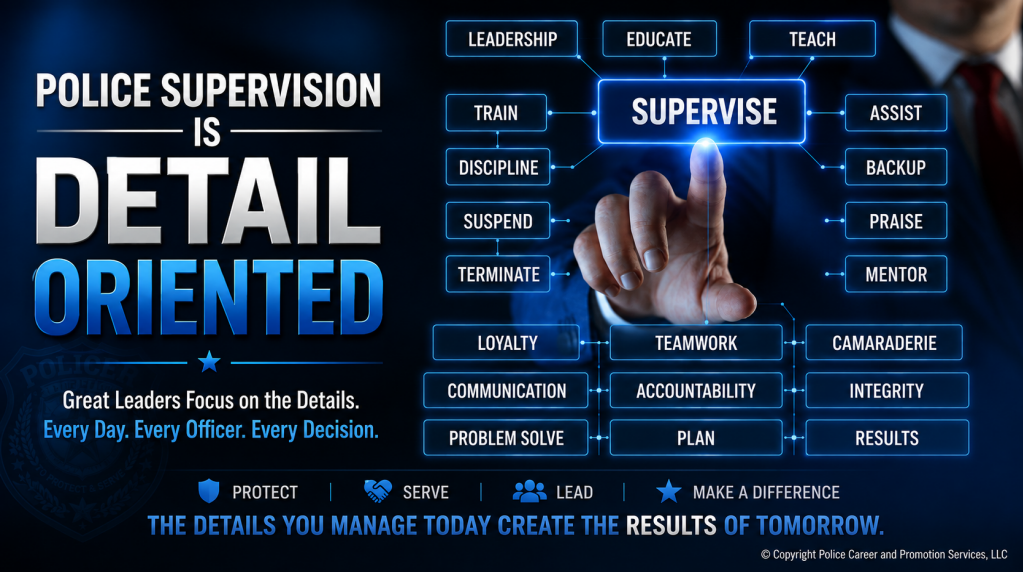
Like the graphic at the top of this page points out, if YOU want to be promoted to a police leadership position, you have to concentrate each day on at least two-dozen important leadership tasks and activities. More than that, you need to have an always-on, always-watching leadership mindset, knowing that the very next critical call for service you will be rushing to will test your communication and problem solving skills, your integrity, accountability, and the teamwork you have fostered in your people.
When someone possesses this skill, they are often thorough, accurate, and careful. They meticulously observe and keep track of details, no matter how small, in their responsibilities.
Detail-oriented individuals are also known for their precision — encompassing tasks from careful proofreading to thorough scrutinizing of lengthy reports, to spotting inconsistencies in complex datasets.
Detail Oriented - Does That Mean You Are Perfect?
Being detail-oriented is often mistaken for perfectionism. While perfectionists struggle with completion because they focus excessively on unattainable standards, detail-oriented individuals emphasize functionality, ensuring all tasks are completed thoroughly and on time.
In a law enforcement promotion context, the officer who can't finish the in-basket because they spent 45 minutes perfecting one memo is not detail oriented — they are a perfectionist. Detail orientation means doing it right AND finishing it.
A detail-oriented person excels in the careful, precise management of details. They are often meticulous, organized, and methodical, with a keen eye for spotting errors or inconsistencies that others might overlook. They are typically excellent planners who anticipate potential issues and devise solutions in advance.
Detail Oriented - Law Enforcement
Specifically Demands It
The academic name for what is called "detail oriented" is conscientiousness — and the research on it is extensive. 100+ years of psychological research has shown conscientiousness — the tendency toward self-efficacy, orderliness, achievement, and self-discipline — to be the best predictor of job performance.
In a landmark meta-analysis by Barrick and Mount covering 117 studies and over 23,000 participants, conscientiousness was the only Big Five personality trait that predicted job performance across all occupational categories studied. This finding has been replicated hundreds of times since.
Conscientiousness breaks down into smaller components:
orderliness
industriousness
self-discipline
dependability, and
a drive toward achievement. Detail orientation lives mostly inside orderliness and dependability — the parts of conscientiousness concerned with organization, accuracy, and follow-through.
Law enforcement performance management systems identify attention to detail in case files and evidence logs as critical. Key competencies scored in supervisor evaluations include judgment and decision-making, attention to detail, objectivity, fact-finding, interpersonal skills, teamwork, and credibility.
The U.S. Department of the Interior Police Competency Model — a revalidation study of the U.S. Office of Personnel Management's government-wide police competency model — identifies as a critical competency: "Is thorough when performing work and conscientious about attention to detail." This was identified as one of the most critical competencies for successful performance of police work across the Department.
Indeed identifies attention to detail as one of the 13 essential skills for a police officer. Attention to detail allows you to identify potential evidence, prevent criminal activity, and identify the correct car or suspect linked to a crime. Good police officers who show exceptional attention to detail are most likely to continue that positive talent when leading other officers in a supervisory role.
Detail Oriented - a Job for the In-Basket!
A
University of San Diego police leadership study found
that law enforcement leaders must have an acute attention to
detail that allows them to perform at their best while
juggling multiple responsibilities.
In this article, Lieutenant McLean stated: "Law
enforcement executives need to master attention to detail in
order to build crucial relationships within the agency and
community; to enhance the performance of the agency; and to
build legitimacy and, thus, buy-in from the officers and the
community."
Key competencies scored in
supervisor evaluations include judgment and decision-making,
attention to detail,
objectivity, fact-finding, interpersonal skills, teamwork,
and credibility.
Assessment center in-basket exercises grade candidates on several parameters specifically related to attention to detail, such as checking all items first before beginning detail work on any one, checking all phone messages first in case any are urgent, and taking each item as far as it can be taken before having to leave a message or issue a request.
The in-basket evaluates how individuals prioritize, delegate, and respond to demands that mirror those of a manager. One key advantage of the in-basket is its ability to predict on-the-job behaviors by assessing practical decision-making under simulated pressures — allowing organizations to observe responses without real-world risks to operations or personnel.
The research from ResearchGate confirms the Texas police sergeant in-basket study: twenty male police officers in a medium-sized Texas city were administered an in-basket test in conjunction with a traditional promotional exam for sergeant. Results indicated the in-basket test contributed uniquely to the exam and correlated significantly with several criterion measures. A subsequent Civil Service Commission ruling upheld the legitimacy of the in-basket test for use in promotional examinations.
Becoming a Detail Oriented Police Leader
 Exercise
— Detail orientation is a muscle. If you exercise it regularly,
reducing errors will become second nature. Physical repetition
builds a life-long positive attribute in your police leadership
career.
Exercise
— Detail orientation is a muscle. If you exercise it regularly,
reducing errors will become second nature. Physical repetition
builds a life-long positive attribute in your police leadership
career.
Develop
a Personal Quality-Control Checklist and System —
Attention to detail is a skill that is innate to some people,
but is also one that can be learned by others. Go to your
department mentor, or a sergeant, lieutenant or captain you
admire. Ask him or her this brief but important question; "With
so much going on every day, every shift, how do you keep focused
on the details?" The response may surprise you, and might
include; organizing your environment, training with
focus-enhancing games, reading slowly, practicing mindfulness,
avoiding multitasking, and using double-check rituals, all to
help sharpen attention to detail.
Read the Instructions —
Maybe you can "wing it" when building an Ikea Entertainment
Center. But don't try that with the next search warrant
execution you are going to supervise. The reports, the case
files, the warrant application, the search warrant itself, those
are the instructions, those are the DETAILS. You should know
those details stone cold, without referring to the documents, or
your notes.
Read and Review BEFORE
Sending — The officer who reads their own report
before handing it in builds the habit of catching their own
errors. The officer who never re-reads never knows what they are
missing.
Get Enough Sleep
— Science shows that a lack of sleep can seriously impact
concentration levels, alertness, thinking processes, and overall
cognitive performance. Without proper sleep, it is easier to
miss errors, make more mistakes, and make poor decisions.
Regardless of which schedule you are on, but especially with the
12-hour workday in many agencies, prioritizing 7 or 8 hours of
sleep a day is critical not only for a detail-oriented leader
but on general officer-safety principles as well.
Train and Stay Sharp —
Crossword puzzles train pattern recognition, vocabulary, and
sustained attention. Try one puzzle per week and time yourself;
track whether your completion time improves over a month. If you
hate crossword puzzles, find another outlet to keep your
concentration and focus sharp.
Practice Active Listening
— Active listening is crucial for understanding tasks correctly
and avoiding mistakes. When you actively listen, you focus
entirely on the speaker, understand their message, and respond
thoughtfully. This ensures that you grasp all the details of
your assignments and meet expectations accurately.
Conclusion - Are We There
Yet?
You've heard the phrase, "The devil is in the details," which mostly is true, but sometimes that's the attraction to NOT obsessing over the details 24/7/365. Life DOES need to be a little chaotic and disorganized at times, as in FUN and SPONTANEOUS. Just, not at work, not at your law enforcement job, not if you can possibly help it. Officers' lives are on the line, and YOU are their leader, so obsessing over details is always called for.
If you're like me, you've always at least tried to separate police work from family. For me, it was putting on the gear, getting in to the take-home shop, and starting on the way in to work. At that point, it was all the details, all the time. Later on, pulling up to home, I tried my best to leave the obsessing over details behind, and just enjoy a wonderful, if slightly chaotic, family life.
Detailed sources and articles to further your understanding;
University of San Diego —
Police Leadership and Attention to Detail
Forbes —
Conscientiousness as Job Performance Predictor
JobCannon —
Conscientiousness and Promotion Guide
Springer —
Personality Traits and Internal Promotions
Neurolaunch —
Detail-Oriented Personality Traits
Alooba —
Detail-Oriented Skills Assessment
Yulys —
Detail Oriented Meaning and Workplace Application
Oak Innovation —
Detail-Oriented in the Workplace
DOI Police Competency Model
(Federal Government PDF)
Indeed —
13 Skills for a Police Officer
PerformYard —
Law Enforcement Performance Evaluations
FSTC —
Assessment
Center In-Basket Scoring Parameters
Grokipedia —
In-Basket Test
ResearchGate —
In-Basket Validity for Police Sergeant Promotion
BetterUp —
Detail Orientation as a Muscle
CareerAddict —
How to Improve Attention to Detail
Mendi —
Mastering Attention to Detail
CareerBuilder —
Practical Attention to Detail Techniques
Pliability —
20 Exercises to Improve Attention to Detail
UpJourney —
43 Ways to Improve Attention to Detail at Work
COPJOT —
Vital Skills of a Good Police Officer
TheMindFool —
Detail
Oriented Traits and Development
Be sure to also check our in-depth
In-Basket Assessment page.Master list of articles and resources: from PolicePromotion.net
Your Police Promotion Timeline — When Should
Preparation Begin?
Field Training — Your First Defining Chapter
Building Your Promotional Reputation Over Time
How Citizen Complaints Can Affect Your Promotion Chances
Recordkeeping —
Your Evaluations, and Training Documentation
Great Police Leaders Focus on the Details — Here's How!
The Two Tracks —
Supervision vs. Specialization
The Role of College Education
in Law Enforcement
The FTO As an Early Promotion Credential
The Written Promotional
Exam — What It Covers and How to Prepare
The Oral Board — the
Promotion First-Timer's Biggest Challenge
The In-Basket Exercise
— NOT as
Easy as You Think!
Assessment Center Exercises
—
Don't Fear — Prepare!
Making it To The Top — Or — How High is
High Enough?
When it's Time to Leave it All Behind — And What to
do Next.Do You REALLY Want the Promotion? — Links to help you prepare for:
Police Corporal
Police Detective
Police Sergeant
Police Lieutenant
Police Captain
Police
Administration and Upper Management
Understanding Police Leadership Concepts
Understanding Police Ethical Considerations
Understanding Police
Patrol and Field Operations
Understanding Community
and Problem-Oriented Policing
Understanding Intelligence-Led Policing
Police Case Law
Application with Case Law Pro